


Sisal Fibre Future Sustainable Strength from Agave to Eco Friendly Materials
Plastic did not become common because it was beautiful. It became common because it was cheap, strong, light, and easy to shape. The challenge now is clear: keep the useful performance of modern materials while cutting waste, pollution, and resource pressure.
Sisal fibre is one of the natural materials stepping into that gap.
Made from the long leaves of the Agave sisalana plant, sisal is tough enough for rope, mats, sacks, brushes, geotextiles, and composite panels. It grows in hot, dry regions where many crops struggle. It needs far less water than thirsty fibres such as cotton. At the end of its life, it is 100% biodegradable under natural conditions, which gives it a clear edge over many synthetic alternatives.
Across Brazil, Tanzania, Kenya, and other sisal-growing regions, this fibre is no longer just a traditional agricultural product. It is becoming part of a wider shift towards renewable, lower-impact materials.

Sisal starts with the Agave sisalana plant
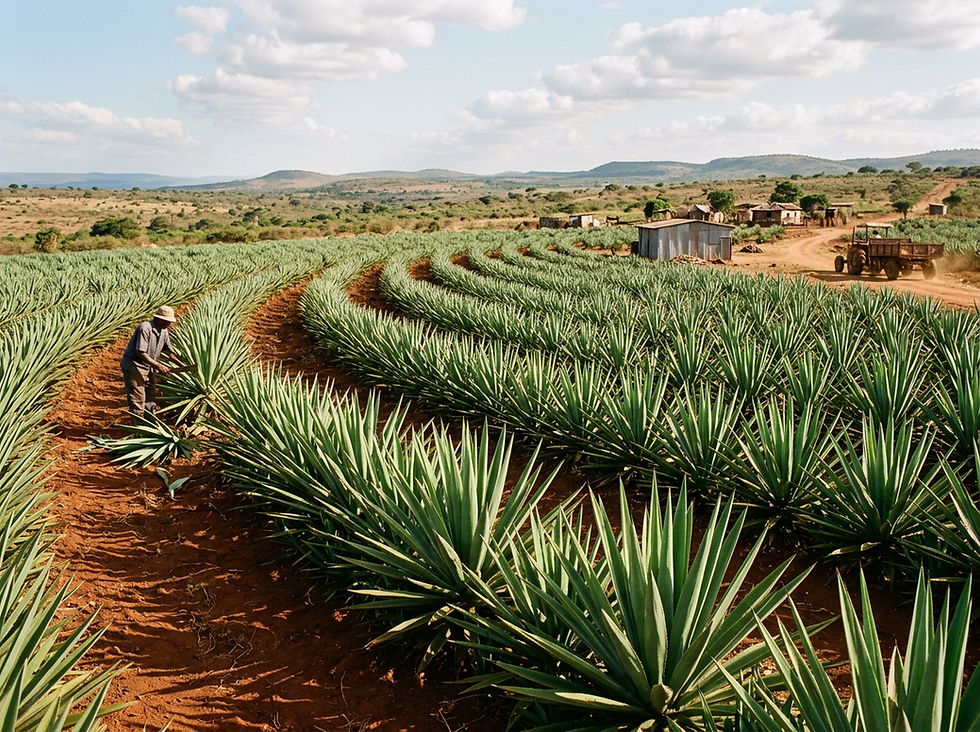
Sisal fibre comes from Agave sisalana, a spiky, drought-tolerant plant with long sword-shaped leaves. Although sisal is often linked today with East Africa and Brazil, the plant has roots in Mexico and takes its name from the port of Sisal in Yucatán, where fibre was historically shipped.
The plant’s strength lies in its leaves. Each leaf contains bundles of long fibres running from base to tip. Once extracted and dried, these fibres become the pale cream strands used in rope, twine, carpets, mats, and newer bio-based materials.
Sisal grows well in semi-arid areas. It can handle heat, poor soils, and irregular rainfall better than many commercial crops. That makes it valuable in regions where water is limited and farming choices are narrow.
Where sisal is grown today
Brazil is one of the world’s major sisal producers. Much of its sisal cultivation happens in dry north-eastern regions, where the plant fits local climate conditions. Sisal provides raw material for export and supports rural livelihoods through farming, processing, and fibre preparation.
Tanzania also has a long sisal history. Large estates and smallholder farms have grown sisal for decades, especially in coastal and inland areas suited to the crop. The country has been an important supplier for global rope, twine, and industrial fibre markets.
Kenya grows sisal in warm, dry regions too, including areas where the plant’s low water needs are a practical advantage. Kenyan sisal is used in ropes, mats, sacks, and increasingly in value-added products such as décor, handicrafts, and natural fibre composites.
Across these countries, sisal matters for more than export earnings. It offers a crop that can fit into dryland agriculture without the same irrigation burden as many alternatives.
Why sisal belongs in the future of sustainable materials
The future of materials will not rely on one perfect fibre. It will need a mix of renewable, recyclable, durable, and biodegradable options matched to the right uses. Sisal fits that future because it answers several material problems at once.
It is fully biodegradable
Sisal is a plant fibre. When untreated or processed with biodegradable finishes, it breaks down naturally at the end of its useful life. Unlike many petroleum-based plastics, it does not persist for centuries as permanent waste.
This matters for products that face wear and eventual disposal, such as agricultural twine, erosion-control mats, packaging, garden products, and some home goods. A sisal product can return to the soil rather than leaving behind microplastic fragments.
Sisal’s strongest sustainability argument is simple: it combines useful strength with a natural end-of-life path.
It needs relatively little water
Sisal is drought-tolerant. It does not demand heavy irrigation in the way that some fibre crops do. Cotton, for example, can require large amounts of water depending on where and how it is grown. Sisal’s lower water requirement makes it attractive in a warming world where rainfall is less reliable.
For countries such as Kenya and Tanzania, where water stress affects many farming areas, low-water crops can help reduce pressure on local resources. That does not mean sisal farming has no environmental footprint. Land use, processing, transport, and chemical treatments still matter. Yet as a crop, sisal begins with a clear ecological advantage.
It uses a renewable plant source
Sisal plants can be harvested repeatedly over their productive life. Farmers cut mature leaves while the plant continues to grow. This makes sisal a renewable fibre source when farms are well managed.
The leftover pulp from fibre extraction can also have value. It may be used in composting, animal feed trials, biogas production, or soil improvement, depending on local systems and regulations. Better use of these by-products can improve the overall sustainability of sisal processing.

How sisal is harvested and processed
Sisal fibre is not made in a laboratory. Its first steps are practical, physical, and often labour-intensive.
Farmers harvest mature leaves by cutting them close to the plant. The longest and healthiest leaves usually produce the best fibre. Harvesting requires care because the leaves are stiff, sharp, and heavy.
After cutting, the leaves must be processed quickly. If they sit too long, quality can drop. The main processing stages are:
Decortication Machines crush and scrape the leaves to separate the fibre from the fleshy leaf pulp.
Washing The extracted fibre is cleaned to remove remaining plant material.
Drying Fibre is spread in the sun or dried using controlled systems. Good drying helps preserve colour and strength.
Brushing and grading Dried fibres are brushed, sorted, and graded by length, colour, cleanliness, and strength.
Baling or spinning Fibre may be packed into bales for industrial buyers or spun into twine and rope.
The result is a long, coarse fibre with high tensile strength compared with many other plant fibres. Sisal is naturally stiff and textured, which makes it useful where grip, firmness, and abrasion resistance matter.
What makes sisal fibre unique
Sisal is sometimes judged by old-fashioned uses such as rope and sacks. That sells it short. Those uses exist because the fibre has a rare mix of physical qualities.
It is strong and hard-wearing
Sisal has good tensile strength, which means it resists pulling forces. That is why it has been used for rope, baler twine, and cordage. It also handles friction well, which suits mats, brushes, and textured floor coverings.
Its durability makes it useful in products that need to survive repeated handling. A sisal doormat, for example, can scrape mud from shoes because the fibre is firm and coarse. A soft fibre would flatten too quickly.
It has a useful texture
Sisal is not silky like cotton or fine linen. That roughness is part of its value. The fibre’s texture gives it natural grip and structure.
This is why sisal appears in:
Rope and twine
Rugs and carpets
Cat scratching posts
Brushes
Agricultural sacks
Erosion-control fabrics
Wall coverings
Fibre-reinforced composites
In interior products, sisal brings an earthy, natural look. In industrial products, the same texture offers performance.
It can strengthen composite materials
One of the most promising futures for sisal is in composites. These are materials made by combining fibres with a binding material, such as resin, bioplastic, or cement-based mixtures.
Sisal can help reinforce panels, automotive parts, furniture boards, packaging, and construction materials. It will not replace steel or high-performance carbon fibre where extreme strength is needed. Still, it can reduce the use of synthetic reinforcement in many everyday products.
For manufacturers, the appeal is clear. Sisal is renewable, relatively light, and strong for its weight. With the right treatment and design, it can support lower-impact product development.

Sisal compared with synthetic materials
Synthetic fibres such as polypropylene, nylon, and polyester are common because they are cheap, consistent, and resistant to moisture. They can be engineered for specific strength, stretch, and colour requirements. For some uses, especially where long-term water resistance or exact technical performance is essential, synthetics still perform well.
Sisal offers a different set of advantages.
Material feature | Sisal fibre | Common synthetic fibres |
Source | Renewable plant crop | Usually fossil-based |
End of life | Biodegradable when untreated or naturally finished | Often non-biodegradable |
Water demand during crop growth | Low compared with many fibre crops | No crop water, but fossil extraction and manufacturing impacts apply |
Texture | Naturally coarse and grippy | Can be smooth, flexible, or engineered |
Strength | Strong for a natural fibre | Often very strong and highly consistent |
Waste concern | Breaks down naturally | Can contribute to long-term plastic waste and microplastics |
The key difference is not that sisal beats synthetics in every category. It does not. The real advantage is that sisal performs well enough for many uses while avoiding some of the biggest problems linked to plastic-based materials.
For agricultural twine, soil stabilisation, packaging, home goods, and certain composites, biodegradability can be more valuable than maximum synthetic strength. In these cases, replacing plastic with sisal can reduce long-term waste without sacrificing basic function.
Sisal compared with other natural fibres
Sisal is part of a wider family of natural fibres that includes jute, hemp, flax, coir, cotton, and abaca. Each has its own strengths.
Jute is soft, affordable, and widely used for sacks and bags. It is more flexible than sisal but usually less tough in rough applications.
Hemp is strong and versatile. It can be used in textiles, building materials, paper, and composites. In some regions, though, hemp faces regulatory or supply-chain limits that affect adoption.
Flax produces fine linen fibres and also works in composites. It is often valued where a smoother, higher-quality textile feel is needed.
Coir, which comes from coconut husk, is highly resistant to moisture and decay. It works well in mats, erosion-control products, and horticulture. It is usually coarser and less suitable for spinning into fine cord than some other fibres.
Cotton is soft and comfortable, which makes it ideal for clothing and household fabrics. Its drawback is that conventional cotton can be water-intensive and may rely on heavy agricultural inputs.
Sisal’s advantage sits in a particular middle ground. It is tougher and stiffer than many soft fibres, easier to grow in dry areas than water-hungry crops, and more biodegradable than synthetic substitutes.
Best sisal use cases
Rope, twine, mats, brushes, geotextiles, composites, textured décor, agricultural products
Less suitable sisal use cases
Soft clothing, fine bed linen, stretch fabrics, products needing constant wet exposure without treatment
This makes sisal a practical material rather than a universal one. The best sustainable choices come from matching the fibre to the job.
Challenges that sisal must overcome
Sisal has a strong future, but it also faces real limits.
Natural fibres vary more than synthetic fibres. Fibre quality can change with rainfall, soil, plant age, harvesting time, drying methods, and storage. Manufacturers need consistent supply and predictable performance, so grading and quality control matter.
Processing can also be improved. Decortication produces large amounts of wet pulp. If this waste is managed poorly, it can create odour and water pollution. If managed well, it can become compost, energy, or a useful agricultural input.
Another challenge is moisture sensitivity. Like many plant fibres, sisal can absorb water. In damp conditions, untreated sisal may swell, weaken, or decay. For some applications, it needs natural coatings, blending, or careful product design.
There is also the question of market value. If sisal-producing communities only sell raw fibre, they may capture a small share of the final product value. More local spinning, weaving, composite production, and finished-goods manufacturing could create better economic returns in countries such as Kenya and Tanzania.
The future of sisal is in better design
The next chapter for sisal is not just growing more plants. It is designing better systems around the fibre.
That means:
Better harvesting tools that reduce labour strain
Cleaner processing with responsible pulp management
Improved grading for consistent quality
Natural treatments that improve moisture resistance
More local manufacturing of finished goods
Stronger links between farmers, processors, designers, and buyers
Sisal can also play a larger role in circular design. A product made with sisal should be planned from the start with its full life in mind. What happens after use? Can it be composted? Can it be repaired? Can it be separated from non-biodegradable parts?
When designers answer those questions early, sisal’s environmental value becomes much stronger.

Why sisal deserves more attention
Sustainable materials often attract attention when they look new or high-tech. Sisal proves that old materials can still solve modern problems.
It comes from a hardy agave plant. It grows in dry regions of Brazil, Tanzania, Kenya, and beyond. It uses relatively little water. It offers strength, grip, and durability. It breaks down naturally after use. It can replace synthetic materials in many practical products and complement other natural fibres where stiffness and toughness matter.
Sisal will not replace every plastic, textile, or construction material. No single fibre can do that. Its value lies in the right applications, especially where strength, biodegradability, and low water demand matter most.
The future of sustainable materials will be built from many smart choices. Sisal is one of the clearest examples: a rugged plant fibre with deep agricultural roots and a growing role in cleaner, more responsible production.


Comments